Posts

ACUTE CARDIAC TAMPONADE

Image
Cardiac tamponade ( pericardial tamponade,  cardiac compression ) is a clinical syndrome caused by the accumulation of fluid in the pericardial space, resulting in reduced ventricular filling and subsequent hemodynamic compromise.  CAUSES: chest trauma myocardial rupture cancer uremia pericarditis cardiac surgery COMPLAINTS :  Shortness of breath  Weakness  L ightheadedness  C ough.  Retrograde aortic dissection CLINICAL SIGNS : Rapid breathing Weak or absent peripheral pulses BECK's TRIAD(was described by the thoracic surgeon Calude S. Beck in 1935.): pulsus paradoxus (  a fall of systolic blood pressure of >10 mmHg during the inspiratory phase.  ) fast heart rate ECG:  low voltage QRS complexes Echocardiography:  enlarged pericardium or collapsed ventricles X-RAY: enlarged globular-shaped heart. Chest CT and MRT signs. TREATMENT: Peri...

CABG in Patients With Acute MI

CABG in Patients With Acute MI: Recommendations CLASS I 1. Emergency CABG is recommended in patients with acute MI in whom 1) primary PCI has failed or cannot be performed, 2) coronary anatomy is suitable for CABG, and 3) persistent ischemia of a significant area of myocardium at rest and/or hemodynamic instability refractory to nonsurgical therapy is present. (Level of Evidence: B) 2. Emergency CABG is recommended in patients undergoing surgical repair of a postinfarction mechanical complication of MI, such as ventricular septal rupture, mitral valve insufficiency because of papillary muscle infarction and/or rupture, or free wall rupture. (Level of Evidence: B) 3. Emergency CABG is recommended in patients with cardiogenic shock and who are suitable for CABG irrespective of the time interval from MI to onset of shock and time from MI to CABG. (Level of Evidence: B) 4. Emergency CABG is recommended in patients with life-threatening ventricular arrhythmias (believ...

Postoperative (CABG) Antiplatelet Therapy

Image
Postoperative   (CABG)  Antiplatelet Therapy: Recommendations CLASS I 1. If aspirin (100 mg to 325 mg daily) was not initiated preoperatively, it should be initiated within 6 hours postoperatively and then continued indefinitely to reduce the occurrence of SVG closure and adverse cardiovascular events. (Level of Evidence: A) CLASS IIa 1. For patients undergoing CABG, clopidogrel 75 mg daily is a reasonable alternative in patients who are intolerant of or allergic to aspirin. (Level of Evidence: C)                  AND from 2011 ACCF/AHA CABG Guideline

Bypass Graft Conduit: Recommendations

Image
Bypass Graft Conduit: Recommendations CLASS I 1. If possible, the left internal mammary artery (LIMA) should be used to bypass the left anterior descending (LAD) artery when bypass of the LAD artery is indicated. (Level of Evidence: B) CLASS IIa 1. The right internal mammary artery (IMA) is probably indicated to bypass the LAD artery when the LIMA is unavailable or unsuitable as a bypass conduit. (Level of Evidence: C) 2. When anatomically and clinically suitable, use of a second IMA to graft the left circumflex or right coronary artery (when critically stenosed and perfusing LV myocardium) is reasonable to improve the likelihood of survival and to decrease reintervention. (Level of Evidence: B) CLASS IIb 1. Complete arterial revascularization may be reasonable in patients less than or equal to 60 years of age with few or no comorbidities. (Level of Evidence: C) 2. Arterial grafting of the right coronary artery may be reasonable when a critical ( 9...

Activated clotting time (ACT) vs aPTT

Activated clotting time  ( ACT ), also known as  activated coagulation time  is a test of  coagulation . [ 1] The ACT test can be used to monitor anticoagulation effects, such as high-dose  heparin  before, during, and shortly after procedures that require intense anticoagulant  administration, such as  cardiac bypass ,  cardiac angioplasty ,  thrombolysis ,  extra-corporeal membrane oxygenation  (ECMO) and continuous  dialysis . [ 1] It measures the seconds needed for whole blood to clot upon exposure to an activator of an intrinsic pathway by the addition of factor XII activators.  It is ordered in situations where the  PTT test  is not clinically useful (i.e., high-dose heparin therapy or presence of lupus anticoagulant). The ACT test is sometimes used, along with the PTT, to monitor the therapeutic effect of a direct thrombin inhibitor, such as argatroban or bivalirudin.  The ACT is measured...

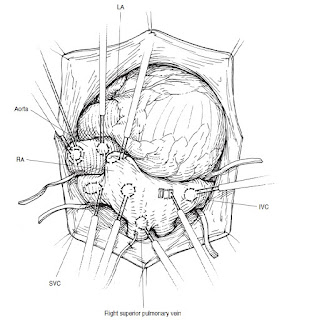
Positions of sites for cannulae and catheters.

Image
Positions of sites for cannulae and catheters Kirklin

Mitral regurgitation, perioperative hemodynamic goals

Mitral regurgitation` Heart rate/rhythm  Low heart rates are deleterious: 80-100 beats/min (sinus rhythm) ideal range  Patients often present with atrial fibrillation Preload/contractility  Maintain preload and contractility Systemic and pulmonary vascular resistance Decrease in left ventricular afterload (decrease in systemic vascular resistance) can reduce the degree of regurgitation through the valve Pulmonary hypertension may occur with chronic mitral regurgitation (often combined with mitral stenosis) and require pharmacological treatment