Posts

Showing posts with the label preoperative

Surgical Site Infection Reduction
Image
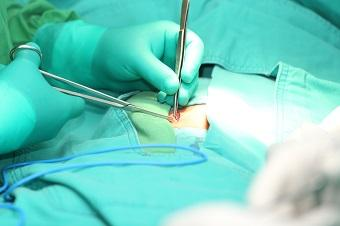
  Surgical Site Infection Reduction To help reduce surgical site infections , cardiac surgery (CS) programs should include a care bundle that includes topical intranasal therapies, depilation protocols, and appropriate timing and stewardship of perioperative prophylactic antibiotics, combined with smoking cessation, adequate glycemic control, and promotion of postoperative normothermia during recovery. Moderate-quality meta-analysis have concluded that care bundles of 3 to 5 evidence-based interventions can reduce surgical site infections . This topic has been reviewed extensively with class of recommendation and level of evidence in an expert consensus review by Lazar et al. Evidence supports topical intranasal therapies to eradicate staphylococcal colonization in patients undergoing CS. From 18% to 30% of all patients undergoing surgery are carriers of  Staphylococcus aureus , and they have 3 times the risk of  S. aureus  surgical site infections and bact...

Preoperative Carbohydrate Loading

Image
  Preoperative Carbohydrate Loading

Consumption of Clear Liquids Before General Anesthesia

Image
 Consumption of Clear Liquids Before General Anesthesia

Preoperative Measurement of Albumin for Risk Stratification

Image
  Preoperative Measurement of Albumin for Risk Stratification

Preoperative Measurement of Hemoglobin A1c for Risk Stratification

Image
  Preoperative Measurement of Hemoglobin A 1c  for Risk Stratification Optimal preoperative glycemic control, defined by a hemoglobin A 1c  level

Preoperative management of asthma

Image
Preoperative management of asthma In patients with reversible airway obstruction and bronchial reactivity, preoperative treatment w ith β2-adrenergic agonists and corticosteroids should be considered. β2-adrenergic agonists have been shown to attenuate the reflex bronchoconstriction following endotracheal intubation. Even with this intervention, significant bronchoconstriction and wheezing occurs following intubation.

Practice Guidelines for Acute Pain Management in the Perioperative Setting: An Updated Report by the American Society of Anesthesiologists Task Force on Acute Pain Management

Image
What other guideline statements are available on this topic? These Practice Guidelines update the “Practice Guidelines for Acute Pain Management in the Perioperative Setting,” adopted by the ASA in 2003 and published in 2004.* Why was this guideline developed? In October 2010, the Committee on Standards and Practice Parameters elected to collect new evidence to determine whether recommendations in the existing Practice Guideline were supported by current evidence. How does this statement differ from existing guidelines? New evidence presented includes an updated evaluation of scientific literature and findings from surveys of experts and randomly selected ASA members. The new findings did not necessitate a change in recommendations. Why does this statement differ from existing guidelines? The ASA guidelines differ from the existing guidelines because they provide new evidence obtained from recent scientific literature as well as findings from new surveys...

Prevention of Perioperative Peripheral Neuropathies

Image
  An Updated Report by the American Society of Anesthesiologists Task Force on Prevention of Perioperative Peripheral Neuropathies I. Preoperative History and Physical Assessment  •   When judged appropriate, it is helpful to ascertain that patients can comfortably tolerate the anticipated operative position.  •   Body habitus, preexisting neurologic symptoms,

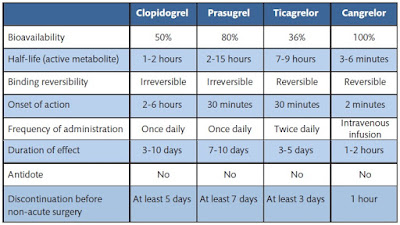
Recommendations for perioperative P2Y12 inhibitor management (EACTS).

Image
    Dual antiplatelet therapy (DAPT) with ASA and P2Y12-receptor  inhibitors (clopidogrel, ticagrelor and prasugrel) (Table) reduces  the risk for thrombotic complications in patients with acute coronary  syndrome (ACS) compared to treatment with ASA only, especially if they undergo percutaneous coronary intervention.  The risk for thrombotic

Perioperative Bleeding Risk Factors

Image
Preoperative Bleeding Risk Factors: Prior bleeding history following surgical procedures Preop coagulopathy Preoperative organ dysfunction Liver disease Kidney disease/renal failure CHF with passive liver congestion  increased LFTs  increased PT History of quantitive or qualitative platelet dysfunction Platelet inhibitors ASA, NSAID GPIIb/IIIa inhibitor Preop anticoagulant use Heparin Warfarin Fibrinolytic administration TPA Streptokinase Urokinase Intraoperative Course: CPB time (over 150 min increases risk) Administration of blood products Transfusion of “pump blood” or autologous blood (heparinized blood) Administration of antifibrinolytics, DDAVP, or serine protease inhibitor Surgical bleeding sites intraoperative Presence of microvascular bleeding at sternal closure

Recommendations for Perioperative Acetylsalicylic Acid Management.

Image
    Acetylsalicylic acid (ASA) is one of the cornerstones for the treatment of acute and chronic cardiovascular disease. Secondary prevention with ASA has been shown to reduce mortality, MI and cerebrovascular events in different subsets of patients with occlusive cardiovascular disease, but also to increase the risk for bleeding complications.     Discontinuation before surgery. A meta-analysis of 13 trials with 2399 patients who had CABG that compared administration of ASA preoperatively versus no treatment or treatment with a placebo showed that treatment with ASA reduced the risk for perioperative MI [(odds ratio (OR) 0.56; 95% confidence interval (CI) 0.33–0.96] but did not reduce the mortality rate (OR 1.16; 95% CI 0.42–3.22). Postoperative bleeding, red cell transfusions and surgical re-exploration were increased with ASA. However, the included studies were of low methodological quality. A recent large randomized controlled trial (RCT) compared the...

Anticholinergics Administered as Pharmacologic Premedication.

Image
         The muscarinic antagonists compete with neurally released acetylcholine ( ACh )   for access to muscarinic cholinoceptors and block  ACh’s  effects. The results are faster heart rate, sedation,  and dry mouth. With the exception of the quaternary  ammonium compounds that do not readily cross the  blood-brain barrier and have few actions on the CNS,  there is no significant specificity of action among these drugs; they block all muscarinic effects with equal efficacy, although there are some quantitative differences in effect.

Perioperative Bleeding Management in Cardiovascular Surgery

Image
  According to   Guidelines from the European Society of Anaesthesiology Cardiovascular surgery:

Blood management in Jehovah's Witness patients.

Image
    Preoperative: Anemia: consider iron, folate, erythropoietin; Anticoagulation: Early withdrawal of antiplatelet agents and warfarin. Switch to unfractionated heparin if necessary;

Risk factors for postoperative pulmonary complications.

Image
Table of risk factors for postoperative pulmonary complications. Click to enlarge: ASA, American Society of Anesthesiologists. 1. Within each evidence category, risk factors are listed according to  strength of evidence, with the first factor listed having the strongest evidence. 2. Subsequent evidence indicates that this is a probable risk factor. Data from Smetana GW, Lawrence VA, Cornell JE, et al: Preoperative  pulmonary risk stratifi cation for noncardiothoracic surgery: systematic  review for the American College of Physicians, Ann Intern Med  2006;144(8):581-595.

Preoperative Fasting and Reducing the Risk of Pulmonary Aspiration

Image
    Recommendations for Clear Liquids.   It is appropriate to fast from intake of clear liquids at least 2 h before elective procedures requiring general anesthesia, regional anesthesia, or sedation/analgesia (i.e., monitored anesthesia care). Examples of clear liquids include, but are not limited to, water, fruit juices without pulp, carbonated beverages, clear tea, and black coffee. These liquids should not include alcohol. The volume of liquid ingested is less important than the type of liquid ingested.     Recommendations for Breast Milk.   It is appropriate to fast from intake of breast milk at least 4 h before elective procedures requiring general anesthesia, regional anesthesia, or sedation/analgesia  (i.e., monitored anesthesia care).     Recommendations for Infant Formula.   It is appropriate to fast from intake of infant formula at least 6 h before elective procedures requiring general anesthesia, regiona...