Posts

Showing posts with the label anesthesia

Safety and Myths About Anesthesia: What You Need to Know Before Surgery

Image
Safety and Myths About Anesthesia: What You Need to Know Before Surgery Keywords : anesthesia, anesthesia safety, myths about anesthesia, preparing for surgery, anesthesia side effects, and general anesthesia The word "anesthesia" often sparks anxiety before surgery. Will you wake up on time? Is it safe for your health? Could it harm you in the long run? Countless myths surround anesthesiology, fueling fears and doubts about modern medical practices. In this article, we’ll debunk the most common misconceptions about anesthesia, explore its safety, and share tips on preparing for surgery so you can feel confident and informed.

Fast track anesthesia approaches

Image
Fast track anesthesia approaches  Keywords:  fast-track anesthesia, anesthesia approaches, perioperative care, rapid recovery, surgery, enhanced recovery, anesthesiology, patient outcomes, postoperative management, minimally invasive Fast track anesthesia schemes are multi-modal approaches that aim to reduce the physiological stress response to surgery, enhance recovery, and improve patient outcomes. These schemes typically involve several aspects of perioperative care, including anesthesia management, surgical technique, pain management, fluid management, and early mobilization. Here are some common fast track anesthesia schemes:

Ketamine: The Past, Present, and Potential Future of an Anesthetic Drug

Image
Ketamine: The Past, Present, and Potential Future of an Anesthetic Drug ketamine, depression treatment, anesthesia, ketamine-assisted psychotherapy, PTSD, esketamine, NMDA receptors, chronic pain Ketamine is a powerful anesthetic drug that has been used in medical settings for decades. However, its effects on the brain have also led to its use as a recreational drug, leading to controversy surrounding its use. Despite its negative associations, recent research has shown promising potential for the drug in the treatment of mental health conditions such as depression and post-traumatic stress disorder (PTSD).

Choosing Between Propofol and Thiopental Sodium

  Propofol and thiopental sodium are both intravenous anesthetic agents used for the induction of anesthesia, but there are several differences between the two agents: Onset and duration of action: Propofol has a more rapid onset of action compared to thiopental sodium, meaning it takes effect more quickly after administration. Propofol also has a shorter duration of action compared to thiopental sodium, which allows for quicker recovery after the procedure. Mechanism of action: Propofol works by enhancing the activity of the inhibitory neurotransmitter GABA, while thiopental sodium enhances the activity of GABA and also inhibits the excitatory neurotransmitter glutamate. Cardiovascular effects: Propofol has a dose-dependent decrease in blood pressure and can cause vasodilation, while thiopental sodium has less of an effect on blood pressure and can cause less vasodilation. Antiemetic properties: Propofol has antiemetic properties, meaning it can reduce the incidence of nausea an...

Behind the Scenes: The Vital Role of Anesthesiologists in Patient Care

Image
  Anesthesiologists play a critical role in patient care, ensuring that patients undergoing surgery or other medical procedures are safe and comfortable. If you are interested in pursuing a career as an anesthesiologist, it is essential to understand the job duties, education requirements, and skills necessary for success in this field.

Malignant Hyperthermia

Malignant Hyperthermia Malignant hyperthermia (MH) is a rare (incidence of 1 in 50,000–70,000 in the UK), autosomal dominant condition, affecting males (62%) more than females (38%) and may occur after many previous anaesthetics.

Mechanisms of General Anaesthetic Action

Image
Anatomical Sites of Action General anaesthetic agents affect both brain and spinal cord to account for physiological responses to nociception, loss of consciousness and inhibition of explicit memory. Auditory and sensory evoked potential data implicate the thalamus as the most likely primary target, but secondary sites such as the limbic system (associated with memory) and certain cortical areas are also

Preoperative Measurement of Hemoglobin A1c for Risk Stratification

Image
  Preoperative Measurement of Hemoglobin A 1c  for Risk Stratification Optimal preoperative glycemic control, defined by a hemoglobin A 1c  level

ASPIRATION

Image
ASPIRATION Risk Factors of Aspiration Patient: Inadequate fasting Delayed gastric emptying Incompetent Lower Oesophageal Sphincter (Emergency, Pregnancy, Diabetes,

Using Midazolam for Sedation and Premedication

Image
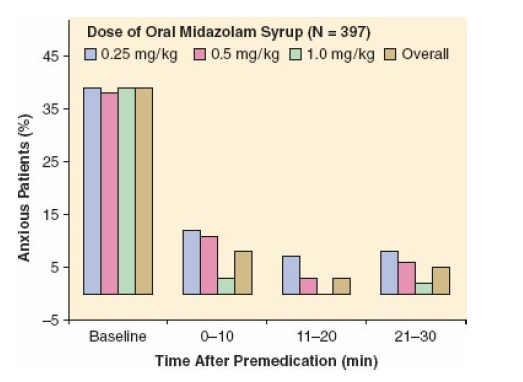
  Midazolam , a benzodiazepine, is currently the drug most commonly used to  reduce preoperative anxiety and induce sedation. It can be administered intravenously and orally. In adults, it can be used to control preoperative anxiety and, during a procedure alone or in combination with other drugs, for intravenous sedation . For children, oral midazolam in doses as small as 0.25 mg/kg

FAILED INTUBATION

Image
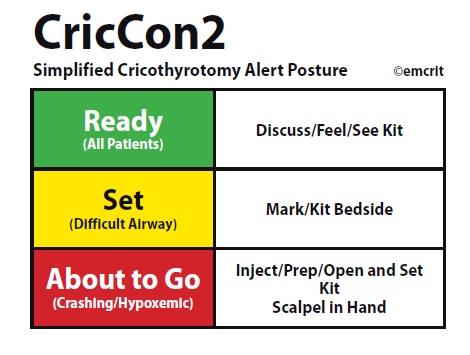
Continue BMV between attempts, call for help and remember each attempt mandates a different approach. 1. If SpO2 permits allow a maximum of 3 attempts. 2. For direct or Macintosh videolaryngoscopy optimize technique, ELM, head position and consider using adjuncts.

Infection Control during Anaesthetic Procedures

Image
The risk of infection is dependent on the procedure and the level of barrier protection. Guidelines for monitoring have been published by the Association of Anaesthetists and should be followed at all times.

How Pregabalin (LYRICA) Works?

Image
Mechanism of action:  Mechanism of action of pregabalin has not been exactly  explained. It  binds with high affinity to the alpha2-delta site -  subunit of voltage-dependent calcium channels  in central nervous system.Thus, calcium currents decrease, which may be associated with the antinociceptive and antiseizure effects of pregabalin.  Nociception   is the recognizing of painful stimuli.

TOPICAL ANESTHETIC

Image
  A number of local anesthetic formulations are available for topical anesthesia , lidocaine, dibucaine, tetracaine, and benzocaine being the drugs used most commonly. In general, these preparations provide effective but relatively short durations of analgesia when applied to mucous membranes or abraded skin. Their efficacy is determined by drug form, melting point, concentration, and skin permeability. Lidocaine and tetracaine sprays are commonly used for endotracheal anesthesia before intubation or for mucosal analgesia for bronchoscopy or esophagoscopy.

ACUPUNCTURE FOR POSTOPERATIVE NAUSEA AND VOMITING

Image
  One of the most promising indications for acupuncture is to prevent postoperative nausea and vomiting ( PONV ). PONV results in patient dissatisfaction, delayed discharge, unanticipated hospital admission, and the use of resources. Drugs have been the mainstay of management, however these have limited effectiveness, are associated with adverse effects, and can be costly. Acupuncture prevents PONV compared with sham acupuncture or no treatment.In two early controlled trials, acupuncture prevented PONV in the pediatric population; however, one literature review of 10 research studies examining the use of acupressure and acupuncture in adults concluded that it is not effective in preventing and managing PONV . Other clinical studies have found that acupuncture prevents PONV and results in a greater degree of adult patient satisfaction. For many of the trials in both adults and children, the PONV acupuncture point was P6 or PC6 (i.e., Nei guan or Pericardium 6). The P6 acupuncture p...

Mixtures of Local Anesthetics

 Mixtures  of  local  anesthetics  for  regional  anesthesia  are sometimes used in an effort to compensate for the short duration of action of certain rapidly acting agents such as chloroprocaine and lidocaine, and the long latency of longer-acting  agents such as tetracaine and  bupivacaine. Mixtures of chloroprocaine and bupivacaine theoretically offer significant clinical  advantages because  of the rapid onset and low systemic toxicity of chloroprocaine and the long duration of action of bupivacaine; however, clinical results in studies of combinations have been mixed. The use of catheter techniques for many forms of regional anesthesia makes it  possible to begin  with a rapid-onset  local anesthetic such as lidocaine, mepivacaine, or  chloroprocaine and then follow with an infusion of either a shorter-acting or longeracting local anesthetic  thereafter. Clinicians  should be cautioned to not...

Сytotoxic Drugs in Anesthetic Practice

Image
 Cytotoxic drugs used in the treatment of malignancy and as immunosuppressive drugs. All may cause nausea and vomiting and bone marrow suppression; most are teratogenic and require careful preparation by trained personnel. Extravasation of iv drugs may cause severe tissue necrosis. Some have side effects of particular anaesthetic/ICU relevance:

Influence of Obesity on Propofol

  Generally, in obese patients, the blood distributes more to nonadipose than to adipose tissues, resulting in higher plasma drug concentrations in obese patients with mg/kg dosing than in normal patients with less adipose mass. ➡

Influence of Obesity on Anesthetic Drugs.

Image
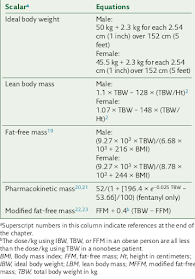
  Anesthesia providers should be familiar with the pharmacologic alterations of anesthetics in obese individuals. In general, manufacturer dosing recommendations are scaled to kilograms of actual total body weight (TBW).➟

Protamine administration

" Heparin and protamine combine in proportion to weight. One milligram of protamine neutralizes 1 mg (typically 100 U) of heparin. Protamine administration:  Always administer protamine slowly. The rate of administration is more important than the route of administration in preventing adverse hemodynamic effects.  One can either use a syringe or dilute the drug in a small volume of intravenous fluid and infuse by gravity  or calibrated pump. Because the syringe technique rather than hand-operated syringe administration, because this reduces the  natural tendency to administer the protamine too quickly and it frees our hands for other  important patient care activities (e.g., vasoactive drug titration, echocardiography examina tion) that coincide with protamine administration. The injected dose of protamine cannot neutralize heparin bound to plasma proteins or  within endothelial cells. Release of heparin from these stored ...