Posts

Showing posts with the label STEMI

CARDIAC SYNDROME X

Image
CARDIAC SYNDROME X (SCX) or microvascular angina is a typical retrosternal chest pain with ischemia documented on noninvasive test (ST depression and/or perfusion abnormality) in the absence of any significant coronary artery disease . Associated with increased cardiovascular risk. 

PRINZMETAL ANGINA (VASOSPASTIC ANGINA, VARIANT ANGINA)

Image
PRINZMETAL ANGINA is severe angina at rest , even asleep with transient ST-segment elevation .  Myron Prinzmetal was an American cardiologist, who was the first to describe this type of angina.   It occurs due to vasospasm, in contrast to stable angina pectoris, which occurs due to atherosclerosis. It is characterized by a deterioration in the patient's condition from midnight to 8:00.

Differential Diagnosis of Cardiovascular Disorders Causing Chest Pain

Image
Cardiovascular Disorders, special Features:

Serum Cardiac Biomarkers

Image
  Creatine kinase (CK) is found in striated muscle and tissues of the brain,  kidney, lung, and GI tract. This marker has low sensitivity and specificity for cardiac damage,  and total CK levels may be elevated in a number of noncardiac conditions, including trauma, seizures, renal insufficiency, hyperthermia, and hyperthyroidism. As a result,  the total CK  marker largely has been replaced by cardiac troponins and CK-MB.

Contraindications to Fibrinolytic Therapy in Patients with STEMI

Image
Contraindications to Fibrinolytic Therapy in Patients with STEMI Absolute Contraindications: Any prior intracranial hemorrhage Known structural cerebral vascular lesion Known intracranial neoplasm (primary or metastatic) Ischemic stroke within the past 3 months (except for acute stroke within 4.5 hours) Suspected aortic dissection Active bleeding or bleeding diathesis (excluding menses) Significant closed-head or facial trauma within 3 months Intracranial or intraspinal surgery within 2 months Severe uncontrolled hypertension (unresponsive to emergency therapy) For streptokinase (no longer marketed in the US): Prior treatment within previous 6 months Relative Contraindications: History of chronic, severe, poorly controlled hypertension Systolic pressure >180 mm Hg or diastolic pressure >110 mm Hg History of prior ischemic stroke >3 months Dementia Known intracranial pathology not covered in absolute contraindications Traumatic or p...

Choice between coronary artery bypass grafting and percutaneous coronary intervention.

Image
FAVOURS percutaneous coronary intervention (PCI):

Stable Angina or Silent Ischaemia: Indications for Revascularisation 2019

Image
Stable Angina also known as 'effort angina', this refers to the classic type of angina related to myocardial ischemia.

When do you use pacemaker for myocardial infarction?

Image
CLASS I (strong) of recommendation, LEVEL B-NR of evidence (moderate-quality evidence from 1 or more well-designed, well-executed nonrandomized studies, observational or registry studies; meta-analyses of such studies)

Resuming sex after a heart attack

Image
After a heart attack or revascularization procedure, many people wonder whether it will be safe to resume sexual activity, and if so, when. They may worry about having another heart attack, or about dying during intercourse. If they have had bypass surgery, they may worry that sexual activity might be painful. Despite the importance of sex in a healthy relationship, many people (including doctors) are uncomfortable discussing it. As a result, questions go unasked, and information is not volunteered. The whole issue becomes the elephant in the room.

What the most accurate test is: creatine kinase-MB or troponin?

Image
Creatine kinase-MB (CK-MB) is a form of an  enzyme  found primarily in heart muscle cells.

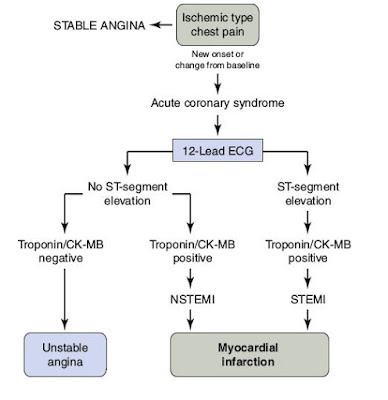
Terminology of acute coronary syndrome.

Image
    Acute coronary syndrome  ( ACS ) is a syndrome (set of signs and symptoms) due to decreased blood flow in the coronary arteries such that part of the heart muscle is unable to function properly or dies.

Subendocardial vs Transmural Myocardial Ischemia.

Image
    The criteria for MI are divided into two categories: ST-segment elevation MI (STEMI) , and ST-segment depression/T-wave change MI (NSTEMI) . The J point is located at the juncture of the QRS complex and the ST segment, and it is used to measure the magnitude of the ST-segment deflection as compared with the baseline of the ECG.     A new J-point elevation of 0.1 mV or greater is required in all leads except V2 and V3 to meet the criteria for STEMI. J-point elevations of up to 0.25 mV may be seen in leads V2 and V3 in healthy men younger than 40 years of age; however, this finding decreases with age and is less prominent in women. For this reason, a range of J-point elevation criteria for MI are defined for V2 and V3 leads: 0.2 mV or greater for men 40 years old and older, 0.25 mV or greater for men younger than 40 years of age, and 0.15 mV or greater for women. he J-point elevations must be seen in two or more contiguous leads for the satisfaction o...

RELATIVE CONTRAINDICATIONS TO DIAGNOSTIC CARDIAC CATHETERIZATION

Image
RELATIVE CONTRAINDICATIONS TO DIAGNOSTIC CARDIAC CATHETERIZATION 1. Uncontrolled ventricular irritability: the risk for ventricular tachycardia/fibrillation during catheterization is increased if ventricular irritability is uncontrolled 2. Uncorrected hypokalemia or digitalis toxicity 3. Uncorrected hypertension: predisposes to myocardial ischemia and/or heart failure during angiography 4. Intercurrent febrile illness 5. Decompensated heart failure, especially acute pulmonary edema 6. Anticoagulation state; international normalized ratio (INR)  >1.8, femoral approach 7. Severe allergy to radiographic contrast agent 8. Severe renal insufficiency and/or anuria, unless dialysis is planned to remove fluid and radiographic contrast load IDENTIFICATION OF THE HIGH-RISK PATIENT FOR CATHETERIZATION Age • Infant: < 1 y old • Elderly: > 70 y old Functional class • Mortality ↑ 10-fold for class IV patients compared with I and II ...

Electrocardiographic Signs of Ischemia

Image
  Ischemic changes, depending on localization of Myocardium Ischemia and Infarction see below. They involve changes in T-wave morphology, including inversion, tenting, or both. More obvious ischemia may be seen in the form of progressive ST-segment depression. Down-sloping and horizontal ST depressions are of greater specificity for ischemia than is up-sloping depression.

LOCALIZATION OF CULPRIT ARTERY IN STEMI. MNEMONIC

Image

Elevations of troponin not caused by an acute coronary syndrome

Image
◆ Cardiac contusion, or other trauma including surgery, ablation, pacing, etc. ◆ Congestive heart failure—acute and chronic. ◆ Aortic dissection. ◆ Aortic valve disease. ◆ Hypertrophic cardiomyopathy. ◆ Tachy- or bradyarrhythmias, or heart block. ◆ Apical ballooning syndrome (Takotsubo). ◆ Rhabdomyolysis with cardiac injury. ◆ Pulmonary embolism, severe pulmonary hypertension. ◆ Renal failure. ◆ Age (>70 years). ◆ Acute neurological disease, including stroke or subarachnoid haemorrhage. ◆ Infiltrative diseases, e.g. amyloidosis, haemochromatosis, sarcoidosis, and scleroderma. ◆ Inflammatory diseases, e.g. myocarditis or myocardial extension of endo- and pericarditis. ◆ Drug toxicity or toxins. ◆ Critically-ill patients, especially with respiratory failure or sepsis. ◆ Burns, especially if affecting >30% of body surface area. ◆ Extreme exertion .

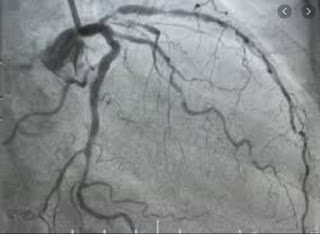
CABG in Patients With Acute MI

CABG in Patients With Acute MI: Recommendations CLASS I 1. Emergency CABG is recommended in patients with acute MI in whom 1) primary PCI has failed or cannot be performed, 2) coronary anatomy is suitable for CABG, and 3) persistent ischemia of a significant area of myocardium at rest and/or hemodynamic instability refractory to nonsurgical therapy is present. (Level of Evidence: B) 2. Emergency CABG is recommended in patients undergoing surgical repair of a postinfarction mechanical complication of MI, such as ventricular septal rupture, mitral valve insufficiency because of papillary muscle infarction and/or rupture, or free wall rupture. (Level of Evidence: B) 3. Emergency CABG is recommended in patients with cardiogenic shock and who are suitable for CABG irrespective of the time interval from MI to onset of shock and time from MI to CABG. (Level of Evidence: B) 4. Emergency CABG is recommended in patients with life-threatening ventricular arrhythmias (believ...