Posts

Showing posts with the label Difficult Airway Algorithm

Difficult Airway Decision Pathways

Image
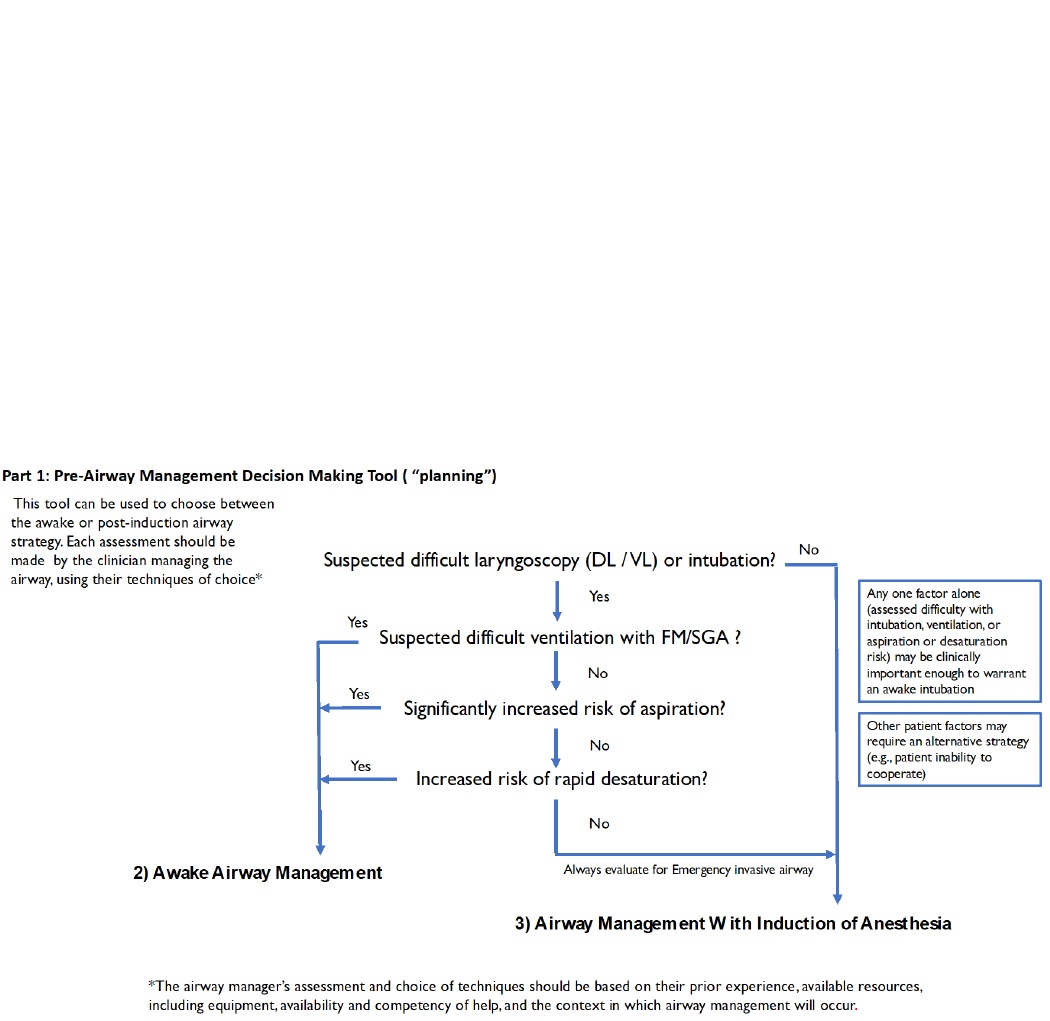
Difficult Airway Decision Pathways   Part 1 is a decision tool that incorporates relevant elements of evaluation and is intended to assist in the decision to enter the Awake Airway Management or Airway Management with the Induction of Anesthesia arms of the ASA difficult airway algorithm.

Recommendations for Unanticipated and Emergency Difficult Airway Management 2022

Image
Recommendations for Unanticipated and Emergency Difficult Airway Management  • Call for help. • Optimize oxygenation. Examples include low or high flow nasal oxygen during efforts securing a tube. • When appropriate, refer to an algorithm and/or cognitive aid.

Recommendations for Evaluation of the Airway 2022

Image
 Before the initiation of anesthetic care or airway management, assure that an airway risk assessment is performed by the person(s) responsible for airway management whenever feasible to identify patient, medical, surgical, environmental, and anesthetic factors (e.g., risk of aspiration) that may indicate the potential for a difficult airway . o When available in the patient’s medical and anesthetic records, evaluate demographic information, clinical conditions, diagnostic test findings, patient/family interviews, and questionnaire responses. o Assess multiple demographic and clinical characteristics to determine a patient’s potential for a difficult airway or aspiration . • Before the initiation of anesthetic care or airway management, conduct an airway physical examination to further identify physical characteristics that may indicate the potential for a difficult airway. o The physical examination may include:  Assessment of facial features: mouth opening, the ability ...

The hyomental distance ratio

Image
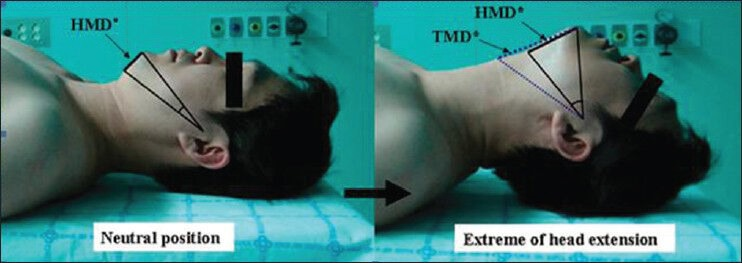
  The hyomental distance ratio (HMDR) is the ratio between the hyomental distance (HMD) (the distance between the hyoid bone and the tip of the chin) at the extreme of head extension (HMDe) and the one in the neutral position (HMDn).   HMDR values ≤ 1.2 as a reliable predictor of difficult intubation.

The ratio of the patient's height to thyromental distance

The ratio of the patient's height to TMD ( thyromental distance)   can be helpful for predicting difficult laryngoscopy.  A ratio of 25 for the RHTMD was found to be the optimal cut-off value to predict difficult laryngoscopy. For example: 165cm/5cm = 33 ( difficult laryngoscopy )

Neck circumference to thyromental distance ratio (NC/TM).

 T he frequency of difficult intubation in obese patients can be predicted with neck circumference to thyromental distance ratio (NC/TM).  The NC/TM ≥5 is a predictor for difficult intubation in obese patients.

Neck Circumference

Image
  Neck circumference is a potentially useful initial screening tool for overweight/obesity. A neck circumference > or = 35.5 cm in men and > or = 32 cm in women should be considered the cutoff point for overweight/obesity.

Interincisor Distance. Mouth-Opening Ability.

Image
  Mouth-opening ability.  This is measured as the interincisor distance. A value of less than 4 cm has been proposed as an indicator of possible difficult intubation. 

Sternomental distance

Image
  Sternomental distance (SMD): It is defined as the distance from the suprasternal notch to the mentum and is measured with the head fully extended on the neck and the mouth closed. A SMD ≤ 13.5 cm is considered predictive of difficult laryngoscopy

Thyromental Distance

Image
   Thyromental Distance The  thyromental distance  (TMD) is defined as the distance from the chin (mentum) to the top of the notch of the thyroid cartilage with the head fully extended; it must be measured with a ruler for accuracy. The TMD gives an estimate of the mandibular space and helps in determining how readily the laryngeal axis will fall in line with the pharyngeal axis when the A-O joint is extended : • A TMD measurement of 6.5 cm or greater with no other abnormalities indicates the likelihood of easy intubation. • A TMD measurement of 6.0 to 6.5 cm indicates that alignment of the pharyngeal and laryngeal axes will be challenging and that difficulty with laryngoscopy may result. However, intubation is possible with the use of adjuncts such as an Eschmann introducer or an optical stylet. • A TMD measurement of less than 6 cm indicates difficult laryngoscopy; specifically, intubation may be impossible. TMD, in conjunction with other p...

Difficult Airway Algorithm

Image
a. Other options include (but are not limited to): surgery utilizing face mask or supraglottic airway (SGA) anesthesia (e.g., LMA(laryngeal mask), ILMA (intubating  laryngeal mask ), laryngeal tube), local anesthesia infiltration or regional nerve blockade. Pursuit of these options usually implies that mask ventilation will not be problematic. Therefore, these options may be of limited value if this step in the algorithm has been reached via the Emergency Pathway. b. Invasive airway access includes surgical or percutaneous airway, jet ventilation, and retrograde intubation. c. Alternative difficult intubation approaches include (but are not limited to): video-assisted laryngoscopy, alternative laryngoscope blades, SGA (e.g., LMA or ILMA) as an intubation conduit (with or without fiberoptic guidance), fiberoptic intubation, intubating stylet or tube changer, light wand, and blind oral or nasal intubation. d. Consider re-preparation of the patient for awak...