Preload
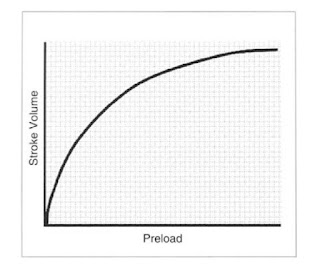
Preload represents the stretch on the muscle just prior to its contraction. Preload in the intact heart is influenced by a number of factors that impact on ventricular filling (and hence end-diastolic stretch). These factors include: blood volume, venous capacitance, ventricular compliance, atrial function, valvular function, heart rate. The Frank-Starling relationship demonstrates increasing stroke volume with increasing preload. Notice that stroke volume is more sensitive to changes in preload at low values compared to high values: How do we estimate preload clinically? With the widespread use of transesophageal echocardiography (TEE), it is possible to get a reasonable estimate of chamber size and, hence, preload. In the absence of TEE, we substitute the pressure at end-diastole with the assumption that the higher the pressure, the greater the size and the greater the stretch on the contractile ele...