Posts

Showing posts with the label ventilation

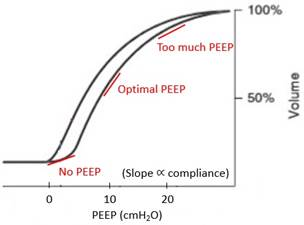
Positive end-expiratory pressure: advantages and disadvantages

Image
All modes will require setting positive end-expiratory pressure (PEEP ). PEEP represents the lowest airway pressure

Extubation Strategies after Cardiac Surgery

Image
Extubation Strategies after Cardiac Surgery  

Vital Capacity Recruitment Maneuver

Image
 A sigh maneuver, or a large tidal volume (Vt), has been suggested for reversing atelectasis; however, atelectasis is not uniformly reduced by a Vt increase or sigh up to airway pressure (Paw) of 20 cm H2O. 

OBSTRUCTIVE SLEEP APNEA

Image
   Obstructive sleep apnea (OSA) syndrome is an often overlooked cause of airway obstruction in the PACU, given that most patients are actually not obese and the vast majority of patients are undiagnosed at the time of surgery.

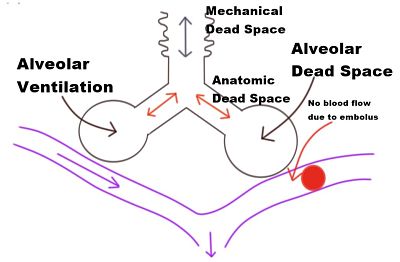
Dead space of the respiratory system

Image
  Dead space is the volume of inspired air that takes no part in gas exchange. Divided into 2 parts: ◗ anatomical dead space : mouth, nose, pharynx and large airways not lined with respiratory epithelium.  ◗ alveolar dead space :  unperfused alveoli . V entilated lung normally contributing to gas exchange, but not doing so because of impaired perfusion. Thus represents one extreme of V̇/Q̇ mismatch .

Asthma Management Guidelines

Image
  The goals for successful management of asthma   include the following   : Achieve and maintain control of asthma symptoms Maintain normal activity levels, including exercise Maintain pulmonary function as close to normal as possible Prevent asthma exacerbations Avoid adverse effects from asthma medications Prevent asthma mortality Asthma symptoms and severity:

Ventilation-Perfusion Mismatch

Image
  V entilation-Perfusion ( V̇/Q̇ ) mismatch is similar to intrapulmonary shunt (V̇/Q̇ = 0) , with some important distinctions.

Preoperative management of asthma

Image
Preoperative management of asthma In patients with reversible airway obstruction and bronchial reactivity, preoperative treatment w ith β2-adrenergic agonists and corticosteroids should be considered. β2-adrenergic agonists have been shown to attenuate the reflex bronchoconstriction following endotracheal intubation. Even with this intervention, significant bronchoconstriction and wheezing occurs following intubation.

Why is obstetric airway management more difficult?

Image
O bstetric patients are at increased risk of failed intubation due to a number of unique clinical, environmental and human factors. Despite widely publicised ‘failed intubation drills’ and advances in airway equipment and techniques, the incidence of failed obstetric tracheal intubation has not changed for more than 40 years, and remains higher than in the non-obstetric population. A recent literature review found an incidence of failed tracheal intubation of 2.6 per 1000 obstetric general anaesthetics (1 in 390) and associated maternal mortality of 2.3 per 100 000 general anaesthetics (one death for every ninety failed intubations). Given the difficulties in accurately predicting difficult intubation, and the unchanged rate of failed obstetric tracheal intubation, there has been a shift in focus away from efforts to primarily reduce rates of failed intubation towards a greater appreciation of measures to maintain oxygenation and to control associated human factors that may i...

Criteria for ICU admission in case of community-acquired pneumonia.

Image
  One of the major or three or more of the minor criteria would indicate ICU admission (IDSA/ATS guidelines ):

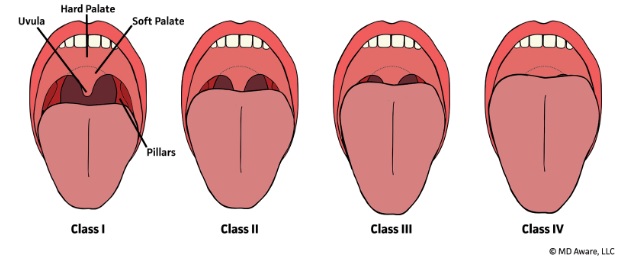
Modified Mallampati Classification

Image
Modified Mallampati Classification appears to be  a clinically useful predictor of   successful intubation.  The score is assessed in a sitting position. Patient is asked to open a mouth and to protrude the tongue as much as possible.

AWAKE INTUBATION ALGORITHM.

Image
    In cases of anticipated difficult intubations, the American Society of Anaesthesiologists and many European authors recommend awake intubation . 

Experts’ guidelines of intubation and extubation of the ICU patient (2)

<< back to beginning Extubation of the ICU patient (Fig. 2 )

Experts’ guidelines of intubation and extubation of the ICU patient

Image
French Society of Anaesthesia and Intensive Care Medicine (SFAR) and French-speaking Intensive Care Society (SRLF)

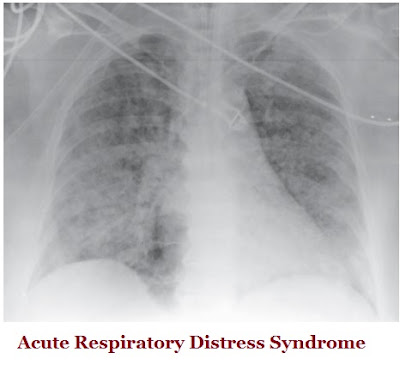
DIAGNOSTIC CRITERIA AND CLINIC SIGNS OF ARDS

Image
     Acute respiratory distress syndrome (ARDS) is a clinical syndrome  of severe dyspnea of rapid onset, hypoxemia, and diffuse pulmonary  infiltrates leading to respiratory failure. Assosiated disorders and causes:

Types of Respiratory Failure.

Image
Type I or “Hypoxemic” Respiratory Failure.  Type I ARF is defined by PaO2 < 60 mm Hg, with normal or decreased PaCO2.   Causes:

Preoperative Fasting and Reducing the Risk of Pulmonary Aspiration

Image
    Recommendations for Clear Liquids.   It is appropriate to fast from intake of clear liquids at least 2 h before elective procedures requiring general anesthesia, regional anesthesia, or sedation/analgesia (i.e., monitored anesthesia care). Examples of clear liquids include, but are not limited to, water, fruit juices without pulp, carbonated beverages, clear tea, and black coffee. These liquids should not include alcohol. The volume of liquid ingested is less important than the type of liquid ingested.     Recommendations for Breast Milk.   It is appropriate to fast from intake of breast milk at least 4 h before elective procedures requiring general anesthesia, regional anesthesia, or sedation/analgesia  (i.e., monitored anesthesia care).     Recommendations for Infant Formula.   It is appropriate to fast from intake of infant formula at least 6 h before elective procedures requiring general anesthesia, regiona...