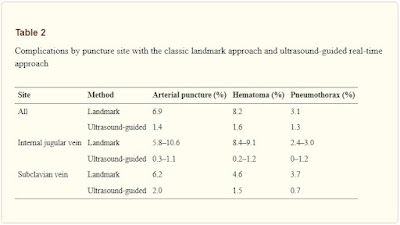
Arterial puncture and hematoma Central venous catheterization rarely accompanies the formation of hematoma. However, with the jugular vein, and particularly when the carotid artery is mistakenly punctured, the formation of a hematoma may block the upper airway. If an artery is mistakenly punctured during SV puncture, external compression to stop the bleeding can be difficult to apply. If a catheter of 7 Fr (equivalent to a diameter of 2.3 mm) or less is inserted into an area, where compression is possible and the catheter can be withdrawn and external compression applied for 10 min, then it can be withdrawn with no problem. In other words, if an artery is mistakenly punctured by a needle thinner than 14 G (equivalent to a diameter of 2.1 mm), hemostasis may be possible via compression. However, if a catheter or dilator larger than 7 Fr is inserted into an artery or a vessel for which compression is not possible, a cardiovascular surgeon should be brought ...
Cardiac tamponade ( pericardial tamponade, cardiac compression ) is a clinical syndrome caused by the accumulation of fluid in the pericardial space, resulting in reduced ventricular filling and subsequent hemodynamic compromise. CAUSES: chest trauma myocardial rupture cancer uremia pericarditis cardiac surgery COMPLAINTS : Shortness of breath Weakness L ightheadedness C ough. Retrograde aortic dissection CLINICAL SIGNS : Rapid breathing Weak or absent peripheral pulses BECK's TRIAD(was described by the thoracic surgeon Calude S. Beck in 1935.): pulsus paradoxus ( a fall of systolic blood pressure of >10 mmHg during the inspiratory phase. ) fast heart rate ECG: low voltage QRS complexes Echocardiography: enlarged pericardium or collapsed ventricles X-RAY: enlarged globular-shaped heart. Chest CT and MRT signs. TREATMENT: Peri...