Posts

Determinants of Stroke Volume.

Image
  I.  Ventricular Preload

Physical Activity Guidelines for Americans Summary

Image
Physical Activity Guidelines for Americans Summary    

Diagnosis of Severe Acute Pancreatitis.

Image
    Severe acute pancreatitis is characterized by persistent organ failure  ( > 48 h). Organ failure can be single or multiple. A CT scan or magnetic  resonance imaging (MRI) should be obtained to assess for necrosis  and/or complications. If a local complication is encountered, management is dictated by clinical symptoms, evidence of infection, maturity   of fluid collection, and clinical stability of the patient. Prophylactic  antibiotics are not recommended.

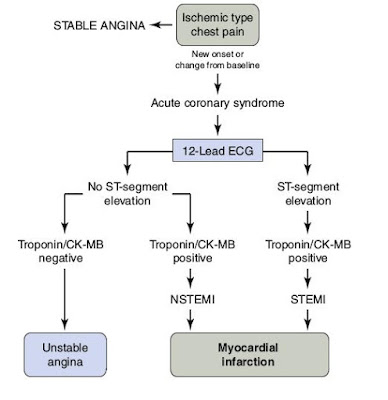
Terminology of acute coronary syndrome.

Image
    Acute coronary syndrome  ( ACS ) is a syndrome (set of signs and symptoms) due to decreased blood flow in the coronary arteries such that part of the heart muscle is unable to function properly or dies.

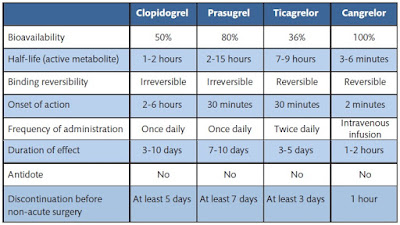
Recommendations for perioperative P2Y12 inhibitor management (EACTS).

Image
    Dual antiplatelet therapy (DAPT) with ASA and P2Y12-receptor  inhibitors (clopidogrel, ticagrelor and prasugrel) (Table) reduces  the risk for thrombotic complications in patients with acute coronary  syndrome (ACS) compared to treatment with ASA only, especially if they undergo percutaneous coronary intervention.  The risk for thrombotic

Types of Respiratory Failure.

Image
Type I or “Hypoxemic” Respiratory Failure.  Type I ARF is defined by PaO2 < 60 mm Hg, with normal or decreased PaCO2.   Causes:

Subendocardial vs Transmural Myocardial Ischemia.

Image
    The criteria for MI are divided into two categories: ST-segment elevation MI (STEMI) , and ST-segment depression/T-wave change MI (NSTEMI) . The J point is located at the juncture of the QRS complex and the ST segment, and it is used to measure the magnitude of the ST-segment deflection as compared with the baseline of the ECG.     A new J-point elevation of 0.1 mV or greater is required in all leads except V2 and V3 to meet the criteria for STEMI. J-point elevations of up to 0.25 mV may be seen in leads V2 and V3 in healthy men younger than 40 years of age; however, this finding decreases with age and is less prominent in women. For this reason, a range of J-point elevation criteria for MI are defined for V2 and V3 leads: 0.2 mV or greater for men 40 years old and older, 0.25 mV or greater for men younger than 40 years of age, and 0.15 mV or greater for women. he J-point elevations must be seen in two or more contiguous leads for the satisfaction o...