Posts

Consequences of Hypernatremia
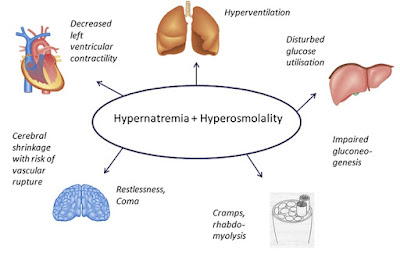
Image
Hypernatremia and the resulting hyperosmolar state impact various bodily functions. One well-known consequence is its influence on neurological function. The occurrence of hypernatremia and subsequent hyperosmolality triggers a movement of free water from within cells to the extracellular space. This shift results in the shrinkage of brain cells, potentially leading to vascular rupture and persistent neurological impairments in severe cases. Cerebral demyelination, a feared complication in addressing hyponatremia, has also been observed in hypernatremia cases of diverse origins. Individuals with end-stage liver disease who develop hypernatremia appear particularly susceptible to cerebral demyelination.

Second vs. Third-Generation Cephalosporins: Key Clinical Differences Explained

Image
Second vs. Third-Generation Cephalosporins: Key Clinical Differences Explained  second-generation cephalosporins, third-generation cephalosporins, clinical differences, antibiotics, bacterial resistance, spectrum of activity, pharmacokinetics, cephalosporin comparison, infection treatment, pharmacology Cephalosporins are a group of antibiotics that are commonly used in the treatment of bacterial infections. They are classified into different generations based on their spectrum of activity against different bacteria. Second and third-generation cephalosporins are two groups of antibiotics that have significant differences in their structure, mechanism of action, and clinical uses. Structure and Mechanism of Action The key difference between second and third-generation cephalosporins is their chemical structure. Second-generation cephalosporins have a shorter side chain than third-generation cephalosporins, which makes them less effective against Gram-negative bacteria.

Third-Generation Cephalosporins: The Powerhouse Antibiotics for Severe Gram-Negative Infections

  Third-generation cephalosporins are a group of antibiotics that are commonly used in the management of bacterial infections. These antibiotics are known for their broad spectrum of activity against Gram-negative bacteria, which makes them particularly useful in the treatment of severe infections caused by these pathogens. Structure and Mechanism of Action

Fast track anesthesia approaches

Image
Fast track anesthesia approaches  Keywords:  fast-track anesthesia, anesthesia approaches, perioperative care, rapid recovery, surgery, enhanced recovery, anesthesiology, patient outcomes, postoperative management, minimally invasive Fast track anesthesia schemes are multi-modal approaches that aim to reduce the physiological stress response to surgery, enhance recovery, and improve patient outcomes. These schemes typically involve several aspects of perioperative care, including anesthesia management, surgical technique, pain management, fluid management, and early mobilization. Here are some common fast track anesthesia schemes:

Understanding Thrombolysis Contraindications: When Breaking Down Blood Clots May Not Be the Best Option"

  Thrombolysis is a medical procedure that involves the use of medication to dissolve blood clots that have formed inside blood vessels. While thrombolysis can be an effective treatment option for certain conditions, there are certain situations where it may not be appropriate due to contraindications.

Ketamine: The Past, Present, and Potential Future of an Anesthetic Drug

Image
Ketamine: The Past, Present, and Potential Future of an Anesthetic Drug ketamine, depression treatment, anesthesia, ketamine-assisted psychotherapy, PTSD, esketamine, NMDA receptors, chronic pain Ketamine is a powerful anesthetic drug that has been used in medical settings for decades. However, its effects on the brain have also led to its use as a recreational drug, leading to controversy surrounding its use. Despite its negative associations, recent research has shown promising potential for the drug in the treatment of mental health conditions such as depression and post-traumatic stress disorder (PTSD).

Choosing Between Propofol and Thiopental Sodium

  Propofol and thiopental sodium are both intravenous anesthetic agents used for the induction of anesthesia, but there are several differences between the two agents: Onset and duration of action: Propofol has a more rapid onset of action compared to thiopental sodium, meaning it takes effect more quickly after administration. Propofol also has a shorter duration of action compared to thiopental sodium, which allows for quicker recovery after the procedure. Mechanism of action: Propofol works by enhancing the activity of the inhibitory neurotransmitter GABA, while thiopental sodium enhances the activity of GABA and also inhibits the excitatory neurotransmitter glutamate. Cardiovascular effects: Propofol has a dose-dependent decrease in blood pressure and can cause vasodilation, while thiopental sodium has less of an effect on blood pressure and can cause less vasodilation. Antiemetic properties: Propofol has antiemetic properties, meaning it can reduce the incidence of nausea an...