Posts

Griepp’s Historical Criteria Describing the Ideal Cardiac Donor

  Griepp’s Historical Criteria Describing the Ideal Cardiac Donor Age < 30 yr No significant medical problems No substance abuse Ischemic time < 2 h No evidence of infection

Difficult Airway Decision Pathways

Image
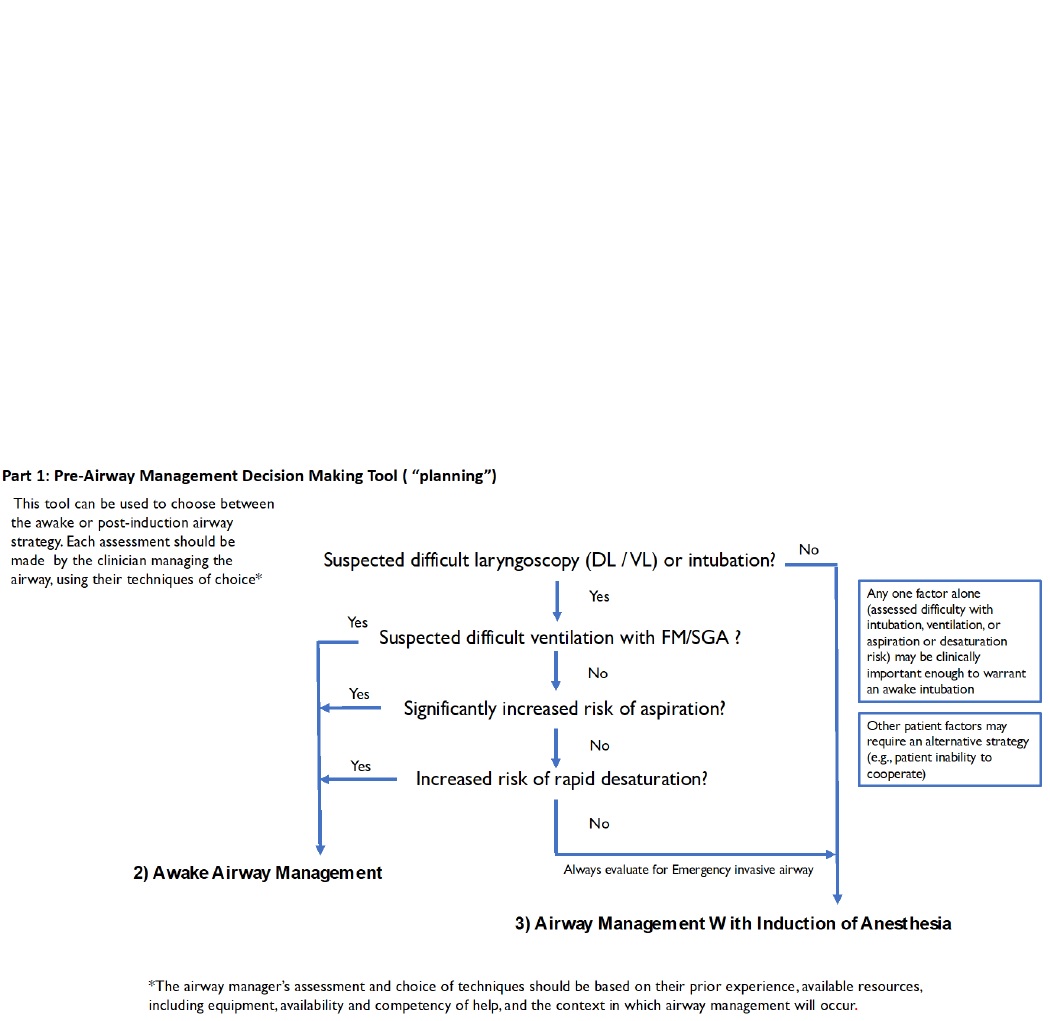
Difficult Airway Decision Pathways   Part 1 is a decision tool that incorporates relevant elements of evaluation and is intended to assist in the decision to enter the Awake Airway Management or Airway Management with the Induction of Anesthesia arms of the ASA difficult airway algorithm.

Recommendations for Unanticipated and Emergency Difficult Airway Management 2022

Image
Recommendations for Unanticipated and Emergency Difficult Airway Management  • Call for help. • Optimize oxygenation. Examples include low or high flow nasal oxygen during efforts securing a tube. • When appropriate, refer to an algorithm and/or cognitive aid.

Recommendations for Evaluation of the Airway 2022

Image
 Before the initiation of anesthetic care or airway management, assure that an airway risk assessment is performed by the person(s) responsible for airway management whenever feasible to identify patient, medical, surgical, environmental, and anesthetic factors (e.g., risk of aspiration) that may indicate the potential for a difficult airway . o When available in the patient’s medical and anesthetic records, evaluate demographic information, clinical conditions, diagnostic test findings, patient/family interviews, and questionnaire responses. o Assess multiple demographic and clinical characteristics to determine a patient’s potential for a difficult airway or aspiration . • Before the initiation of anesthetic care or airway management, conduct an airway physical examination to further identify physical characteristics that may indicate the potential for a difficult airway. o The physical examination may include:  Assessment of facial features: mouth opening, the ability ...
The hyomental distance ratio

Image
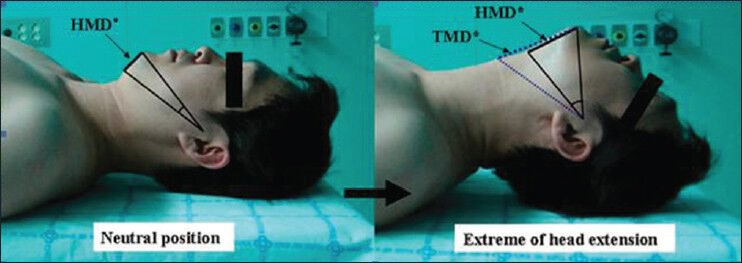
  The hyomental distance ratio (HMDR) is the ratio between the hyomental distance (HMD) (the distance between the hyoid bone and the tip of the chin) at the extreme of head extension (HMDe) and the one in the neutral position (HMDn).   HMDR values ≤ 1.2 as a reliable predictor of difficult intubation.

The ratio of the patient's height to thyromental distance

The ratio of the patient's height to TMD ( thyromental distance)   can be helpful for predicting difficult laryngoscopy.  A ratio of 25 for the RHTMD was found to be the optimal cut-off value to predict difficult laryngoscopy. For example: 165cm/5cm = 33 ( difficult laryngoscopy )

Neck circumference to thyromental distance ratio (NC/TM).

 T he frequency of difficult intubation in obese patients can be predicted with neck circumference to thyromental distance ratio (NC/TM).  The NC/TM ≥5 is a predictor for difficult intubation in obese patients.